In a five day nonstop tour of Viet Nam, Dr. Maddaus and his college-age kids Max and Mike stood like oak trees, experiencing the historic underground military Cu Chi tunnels, ultra cheap Vietnamese massage, overwhelming gawking crowds in quaint rural towns, and the unbeatable hospitality of the Viet people. From the moment the Maddaus crew hit the Sai Gon airport running, the crowds of chaos hit them 360. A little Viet women at the baggage claim threw big bad Max to the side like a small package of Raman noodles in the fight to leave the airport first. Massive crowds of Viets eagerly swarm the exit doors waiting to pick up their arrivals. The ratio of 1 passenger to 10 friends/relatives at the airport created a rock star celebrity type atmosphere.
With their first visit to a developing country, Dr. Maddaus and company wanted to vicariously experience the beauties, hardness, and realities of Viet life. In contrast, typical Vietnamese tourists want to only experience the “Disney Land” life of their destination because a vacation is an opportunity to escape reality and find paradise. Thus, to the Viet people, American tourist taking snapshots of dilapidated buildings, grubby alleyways, and depressingly poor seem absurd, especially without people in the image.
With the help of Hoai’s well-connected Uncle Cong, we hit Sai Gon high class tourist district with some classy seafood to the straight up all Viet dish, Banh Xeo with fish sauce. To balance the big modern life of Viet Nam, Maddaus’ tour company steered them to the Mekong delta to see the Western influences stripped away from the Vietnamese traditional life. Pushed around in Cyclos and not enticed by the persistent, but wickedly silent postcard selling children, their intense five days in Viet Nam left them wanting to come back.
As a side note Dr. Maddaus kindly did a sympathectomy on me for my hyperhydrosis of the palms (AKA sweaty icky hands that caused me a lifetime of anxiety and bad news at high school dances) after my surgery rotation with him was over. He cured it!! And as of today, he remains as one of my favorite characters and physicians. I am blessed to have him as a friend.
Tuesday, February 14, 2006


Sunday, February 05, 2006
Blogger's Nightmare
Ladies and Gents, I am in the middle of a two week break with my girlfriend Krista, traveling the country. That's of course is not the nightmare, but the joy. The nightmare is that my laptop is dead. It will not turn on even though I stare at it with my squinty eyes, thump my fist on the lamented wood of my desk, or curse in indecipherable Vietnamese. Now I will rely on the computer gods in VN to do CPR on the motherboard. Please pray for me and my CPU.
Thursday, January 26, 2006
Maddaus and Company
Back in 2004, I started my very first medical rotation at Fairview University Medical Center. I blindly fell into the Thoracic Surgery team. As a medical rotation greenhorn I did not know what to expect, but I was eager to make my mark. At that point, my long list of possible medical careers was an open field which even included surgery as a possible future. Six weeks later, my acidic reflux roared up my throat like Yellowstone’s Old Faithful and I not so subtly knew surgery was not my destiny; my body simply said no to surgery. Plus it never matched the sexiness of the show “Grey’s Anatomy.”
Yet in the mix of this hell were glimpses of joys that must have been fate. That glimpse came as a stare-you-done-size-you-up doctor known as Dr. Michael Maddaus. My first encounter with him revealed a well-trimmed, well-dressed, tattoo-featuring, straight-to-the-point MD.
I still remember that first day with him on service. The four medical students on the team stood around him as he nonchalantly leaned back on his rolling chair with his hands on the back of his head. One second later, the interrogation/interview began- Where are you from? When is your birthday? Etc…
That interrogation came with dress code commentary. I had forgotten (at least I think I forgot and it was not intentional and that’s what I still tell Dr. Maddaus as of today. Wink, wink) to button my collar button and Dr. Maddaus’ poignant and even-toned advice came as “Did you intentionally do that? You should really button that.” My sidekick to my right got the “you really need to shave” words of wisdom. A week later, Dr. Maddaus noticed my dearth supply of neckties when I wore the same tie 3 times within a 9 day period. He generously and straight-faced invited me to his home (in front of a roaring audience) with “Man, Cuong, I love that tie, but I’ve seen it too many times. If you need some ties, I can give you some of mine. I have tons at home.” While my sidekick to the right of me got “that’s a beautiful tie and I love how you tied it with two dimples like a news anchorman.”
Fortunately behind the no-bull-attitude and ohhh-so-efficient-and-effective-surgical-skills came generosity, faithfulness, and kindness. Yes, his interrogation was likely used to shake us up, but he genuinely cared about our responses and he soaked us up like a sponge. Out of all the physicians I have worked with in my short medical career, Dr. Maddaus has one of the best listening and patient-centered skills. He actually took my advice on a book and sought out to buy it on amazon.com. He wrote down my birthday and called to say happy birthday. He looked beyond my status as his medical student slave and saw me as a peer.
He also saw me as a patient…. That’s another blog story.
Anyway I was excited and surprised to receive an email one day from Dr. Maddaus that he planned to drop by Viet Nam with his two twenty year-old sons…. (To be continued)
For now read his enchanting story online: The Maddaus Story.
Yet in the mix of this hell were glimpses of joys that must have been fate. That glimpse came as a stare-you-done-size-you-up doctor known as Dr. Michael Maddaus. My first encounter with him revealed a well-trimmed, well-dressed, tattoo-featuring, straight-to-the-point MD.
I still remember that first day with him on service. The four medical students on the team stood around him as he nonchalantly leaned back on his rolling chair with his hands on the back of his head. One second later, the interrogation/interview began- Where are you from? When is your birthday? Etc…
That interrogation came with dress code commentary. I had forgotten (at least I think I forgot and it was not intentional and that’s what I still tell Dr. Maddaus as of today. Wink, wink) to button my collar button and Dr. Maddaus’ poignant and even-toned advice came as “Did you intentionally do that? You should really button that.” My sidekick to my right got the “you really need to shave” words of wisdom. A week later, Dr. Maddaus noticed my dearth supply of neckties when I wore the same tie 3 times within a 9 day period. He generously and straight-faced invited me to his home (in front of a roaring audience) with “Man, Cuong, I love that tie, but I’ve seen it too many times. If you need some ties, I can give you some of mine. I have tons at home.” While my sidekick to the right of me got “that’s a beautiful tie and I love how you tied it with two dimples like a news anchorman.”
Fortunately behind the no-bull-attitude and ohhh-so-efficient-and-effective-surgical-skills came generosity, faithfulness, and kindness. Yes, his interrogation was likely used to shake us up, but he genuinely cared about our responses and he soaked us up like a sponge. Out of all the physicians I have worked with in my short medical career, Dr. Maddaus has one of the best listening and patient-centered skills. He actually took my advice on a book and sought out to buy it on amazon.com. He wrote down my birthday and called to say happy birthday. He looked beyond my status as his medical student slave and saw me as a peer.
He also saw me as a patient…. That’s another blog story.
Anyway I was excited and surprised to receive an email one day from Dr. Maddaus that he planned to drop by Viet Nam with his two twenty year-old sons…. (To be continued)
For now read his enchanting story online: The Maddaus Story.
Thursday, January 19, 2006
I declare War on Ants
Viet Nam is a haven for ants. The ants operate in organized chaos like motorbikes on Sai Gon streets. They crawl on my desks, on my bed, in the shower, and towards anything, anything that resembles sweetness of sugar. So watch out Krista, the ants might get you in Viet Nam.
Did Khoa leave open my dear package of Oreos? Yes, the ants devoured the delicious white icing between chocolate wafers before I had one bite. Is that a soda can of less than tasty coca-cola? Well, those ants know and they will swim in delight. What’s that tingling feeling on your back? Yes, that’s a lost ant searching for sugar in your pores. Is that an open package of cereal? Watch out, you might end up with ant cereal.
My advice is if there’s a hint of glucose in that food item, chain it up, case it up, and wrap it up because the ants will attack.
My next war is on those cockroaches. Yuck.
Did Khoa leave open my dear package of Oreos? Yes, the ants devoured the delicious white icing between chocolate wafers before I had one bite. Is that a soda can of less than tasty coca-cola? Well, those ants know and they will swim in delight. What’s that tingling feeling on your back? Yes, that’s a lost ant searching for sugar in your pores. Is that an open package of cereal? Watch out, you might end up with ant cereal.
My advice is if there’s a hint of glucose in that food item, chain it up, case it up, and wrap it up because the ants will attack.
My next war is on those cockroaches. Yuck.
A Day in School
One school per day is not enough for the child from an affluent family in Viet Nam. Understanding the importance of education, many children attend different schools within a day for the entire year. Thus the most fortunate students attend one school in the morning, another school in the afternoon, and an additional school in the summer. Schooling is literally nonstop affair from grades 1 to 12.
Of course, life is different for the average child in Viet Nam. The government schools offer about five hours per day from Monday to Saturday for grades 1 to 12 throughout September to May. Coursework covers the basics of math, science, ethics, manners, literature, and English. Crowded into small classrooms with inadequate textbooks, sixty children often sit quietly in their uniforms in long rows. Frequently homework involves memorizing long literary passages that would later be presented in front of class. It’s a national tradition to memorize lengthy songs and poems.
Furthermore all test and work are based on a ten point system which then translates to student ranking from top to bottom. Most notably public announcements of scores and rankings provide honor to motivate for the best and disgrace to motivate for the worst. Students compete to be the best, realizing that only the best or the rich make it to university schooling.
Unfortunately many students do not finish high school due to family obligations on the farms or small businesses. Poverty compels family to only assess short term survival. Plus the unlikelihood of a student achieving top ranks forces parents to preemptively withdraw their children from school to save time and money.
Of course, life is different for the average child in Viet Nam. The government schools offer about five hours per day from Monday to Saturday for grades 1 to 12 throughout September to May. Coursework covers the basics of math, science, ethics, manners, literature, and English. Crowded into small classrooms with inadequate textbooks, sixty children often sit quietly in their uniforms in long rows. Frequently homework involves memorizing long literary passages that would later be presented in front of class. It’s a national tradition to memorize lengthy songs and poems.
Furthermore all test and work are based on a ten point system which then translates to student ranking from top to bottom. Most notably public announcements of scores and rankings provide honor to motivate for the best and disgrace to motivate for the worst. Students compete to be the best, realizing that only the best or the rich make it to university schooling.
Unfortunately many students do not finish high school due to family obligations on the farms or small businesses. Poverty compels family to only assess short term survival. Plus the unlikelihood of a student achieving top ranks forces parents to preemptively withdraw their children from school to save time and money.
Wednesday, January 18, 2006
Watch out for the "Wind"
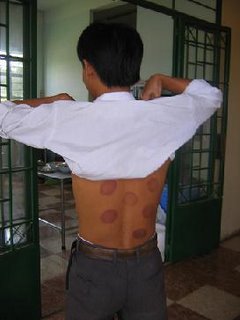 Often Vietnamese traditional medicine stands side-by-side in equal footing with western medicine. The ancient theories and methods rooted in Chinese medicine is part of daily Viet life. Of course the conspicuous and accepted presence of numerous traditional medicine schools shows the strength of eastern medicine. Even medical school teaches traditional medicine in harmony with western medicine.
 A couple months ago at the Third National HIV conference, one of the main lectures involved current traditional medicine research that has shown auspicious improvements of CD4 counts in patients in HIV. My fellow colleagues at Pasteur Institute lauded the presentation and welcomed possible herbal medicine treatments in tandem with ARV. Moreover, a number of audience members at the conference had great hopes for a clearly laid out traditional medicine regimen that will someday lessen the symptoms of HIV/AIDS. Thus it is more likely than unlikely that Vietnamese physicians in the future will find methods to combat HIV/AIDS with prevention, care, ARVs, and herbs.
The energy known as “Qi” guides the foundation of Vietnamese Traditional Medicine. Furthermore, the flow and strength of Qi stems from the balance of internal forces which are explained in various fundamental concepts: Hot and Cold, Five Elements (Fire, Earth, Metal, Water, and Wood), 12 Organs and 14 Meridians.
The concept of “hot” and “cold”, which is an extension of Yin and Yang, has been part of my vernacular since childhood. Hot and cold does not translate literally into body temperature, but rather counterbalanced vital physiological forces that maintains health. Excess hot manifests as fevers, redness, constipation, irritability, sleeplessness, canker sores, or discharge while excess cold exhibits itself as a sense of cold, diarrhea, pain, or cramps.
Many Vietnamese believe in the concept of "Catching (hitting) the wind." Extrinsic forces like prolong exposure to “wind” or consumption of unhealthy food can cause an imbalance of hot and cold which consequently leads to illness or death. Often heart attacks, strokes, and symptoms of HIV/AIDs can be interpreted as “hitting the wind.”
Traditional practices usually play the role of correcting this imbalance, but even western medicine can be employed to restore the balance. The following traditional methods can re-equilibrate hot and cold:
- Acupuncture. Needles placed on certain locations of the body to affect specific organs.
- Acupressure or Massage. Using the same concepts as acupuncture, this uses pressure and touch to affect organs.
- Cupping (Giac): Small glasses that are heated and placed on the skin (usually on the back), causing a forceful suction to pull out the bad forces. This leaves red marks at suction points that last for over a week.
- Coining (Cao gio). Coining is used to release this wind. Coins dipped in oil are forcefully rubbed against the skin leaving streaks of redness.
- Pinching (Bat gio). This method is pinching the skin to once again to pull out the “wind”, which again leaves red markings.
- Steaming (Xong). A boiled concoction of herbs to a steam to be inhaled and cover the body.
- Balm or heating oils: Oils like ever popular “Dau Xanh” (Green Oil) or balms that cause significant heating of the skin.
- Do not live in the windy city of Chicago
- Don't put the entire bottle of Tabasco sauce into your chiplote burrito,
- Buy one of those long wooden hand scratchers to rub out that bad Qi.
Monday, January 16, 2006
The Pill Surprise
The family doctors in Viet Nam often struggle to make a buck. So they become creative in milking that last cent, often to the detriment to the patient’s health. VN doctors make money by doing procedures or selling medication. Most family physicians do not offer significant procedures and thus selling medication drives their profit. However in Viet Nam, all citizens can go to any pharmacy and buy medications like the all powerful med vancomycin without a prescription. That means physicians must compete against pharmacies for business. To circumvent all pharmacies, physicians sell their meds in nameless plastic baggies with pills that cover 2-3 weeks. This leaves the patient in a cloud of mystery about the medication and requires them to come back to the original physician for more.
What does this mean for the patient?
What does this mean for the patient?
- Patients often leave with very little understanding of their current health.
- Continuum of care is often broken because patients seldom trust physicians knowing some doctors drive their work on profit.
- Patients do not go to physicians and self-medicate at local pharmacies causing incorrect use of antibiotics and dangerous meds.
- Many cannot afford care in rural areas because they need to repeatedly see the physician for their medications.
- New physicians often receive no documentation of past health history from other previous physicians of the patient.
Thursday, January 12, 2006
My Aunt and Her Return
 My Aunt Chon and her husband Lam returned to Viet Nam for the first time in well over 10 years. This time they bring back a 21 month old boy and another one in the womb waiting to be delivered. Of course their past images of Sai Gon and Viet Nam have become strikingly obsolete. Viet Nam was quietly changing when they last left.
Now it was strange for me to watch my Aunt and Uncle be overwhelmed by the progress and the chaos of the city. Sai Gon blinded their senses – loud streets, unsettling heat, blasting dusts, blinking lights, and suffocating exhaust fumes. These senses coincided with long lost emotions of the past which inevitably leads to sensory overload. Consequently, their visceral reactions resembled my initial reactions in Viet Nam.
They have been so Americanized (or Canadianized since they live in Toronto) that their own Vietnamese roots have also been uprooted like mine. They even speak Viet-lish, throwing in English words that most Vietnamese would not understand in daily conversation. The buzzing motorbikes frighten them when they need to cross their street and they would not dare to drive a motorbike. They don’t know how to snap open plastic bags of towels in that slick poppy way at a restaurant. Thus, life in Viet Nam has become completely foreign to them.
Furthermore, with my 3 months of Viet experience, I look like less of a foreigner than they do. However they live on remnants of their past, holding onto their hazy youth in Viet Nam. Instead I start anew, creating images that will crystallize into my old age. They are trying to let go of the old and welcome the new. I am simply welcoming the new. But within 3 weeks, I expect them to be Viet pros, settling into the carefree Viet life. And then once again, I will look more like a foreigner and amateur than they do.
Sunday, January 08, 2006
Not for Sale
Samples are a big part of business for pharmaceutical companies in the US and Viet Nam. You may think why would a company want to give out little freebies of their big money making drug? Simple, because it’s direct consumer advertising. The doctor gives you a little taste and you’re hooked for life. Also do you notice the generics seldom give out freebies, but the only the big gun pharma do? That means you’re on hooked for life on the most expensive version of the drug. So that freebie of the brand name becomes a future expense. Ohhh, that sly big pharma.
But in Viet Nam business is done differently with samples. Vietnamese doctors are delighted to receive samples not because their patients will receive free treatment, but because that’s extra income to the physician. Many Viet doctors will take those samples and sell it to a local pharmacy. Moreover, patients seek out to buy these sample items because they believe that the “Not for Sale” label delineates a higher quality medication.
But in Viet Nam business is done differently with samples. Vietnamese doctors are delighted to receive samples not because their patients will receive free treatment, but because that’s extra income to the physician. Many Viet doctors will take those samples and sell it to a local pharmacy. Moreover, patients seek out to buy these sample items because they believe that the “Not for Sale” label delineates a higher quality medication.
Thursday, January 05, 2006
Your Nearest Candy Store
Pharmacies work like candy stores here. What’s your favorite flavor of antibiotics? Azithromycin? How about ceftriaxone? Of course clindamycin is a public favorite. You can even get the machine gun known as Vancomycin. You like pills, solutions, or injections? Do you prefer generics or brand names? Or do you prefer some herbal meds?
Once you make your decision, you walk up to the counter. You point to the item you want and it’s yours. You don’t need to waste time and money on prescriptions and doctors notes. It’ easier than naming all the third generation cephalosporins.
When the pharmacy is inclusively all over-the-counter, then your average Khoa in Viet Nam becomes a self-medicating doctor. (By the way, I’ve been told you can buy your own MD diploma without the superfluous education.) From upset stomachs and diarrheas to irritating eyes and sore throats, the Vietnamese love medication. They even give me advice about medicine when I cough.
So when you come to Viet Nam, don’t waste your money at your local Snyder store. Instead you should be your own doctor and enjoy the Vietnamese candy store.
Once you make your decision, you walk up to the counter. You point to the item you want and it’s yours. You don’t need to waste time and money on prescriptions and doctors notes. It’ easier than naming all the third generation cephalosporins.
When the pharmacy is inclusively all over-the-counter, then your average Khoa in Viet Nam becomes a self-medicating doctor. (By the way, I’ve been told you can buy your own MD diploma without the superfluous education.) From upset stomachs and diarrheas to irritating eyes and sore throats, the Vietnamese love medication. They even give me advice about medicine when I cough.
So when you come to Viet Nam, don’t waste your money at your local Snyder store. Instead you should be your own doctor and enjoy the Vietnamese candy store.
Subscribe to:
Posts (Atom)